The 2027 CPT code changes for ABA billing take effect January 1, and they’re the first update to the code set since 2019. The ABA Coding Coalition has published a new set covering assessment, non-face-to-face services, and treatment. The adaptive behavior code family grows from 10 codes to 14: six are new, two of the old temporary codes are gone for good, and one familiar code splits in two.
The ABA Coding Coalition is the group of ABA organizations — the Association of Professional Behavior Analysts, Association for Behavior Analysis International, the Behavior Analyst Certification Board, and CASP — behind the code change application the AMA accepted. The coalition built the case for these changes from utilization data collected across health plans and providers, and submitted it directly to the AMA for review. Read the coalition’s own crosswalk and rationale.
If you bill under any of the 2019 codes — 97151 through 97158, or the Category III codes 0362T and 0373T — this affects you. Authorizations, fee schedules, and claim-scrubbing rules built around the old code set all need a look before the switch.
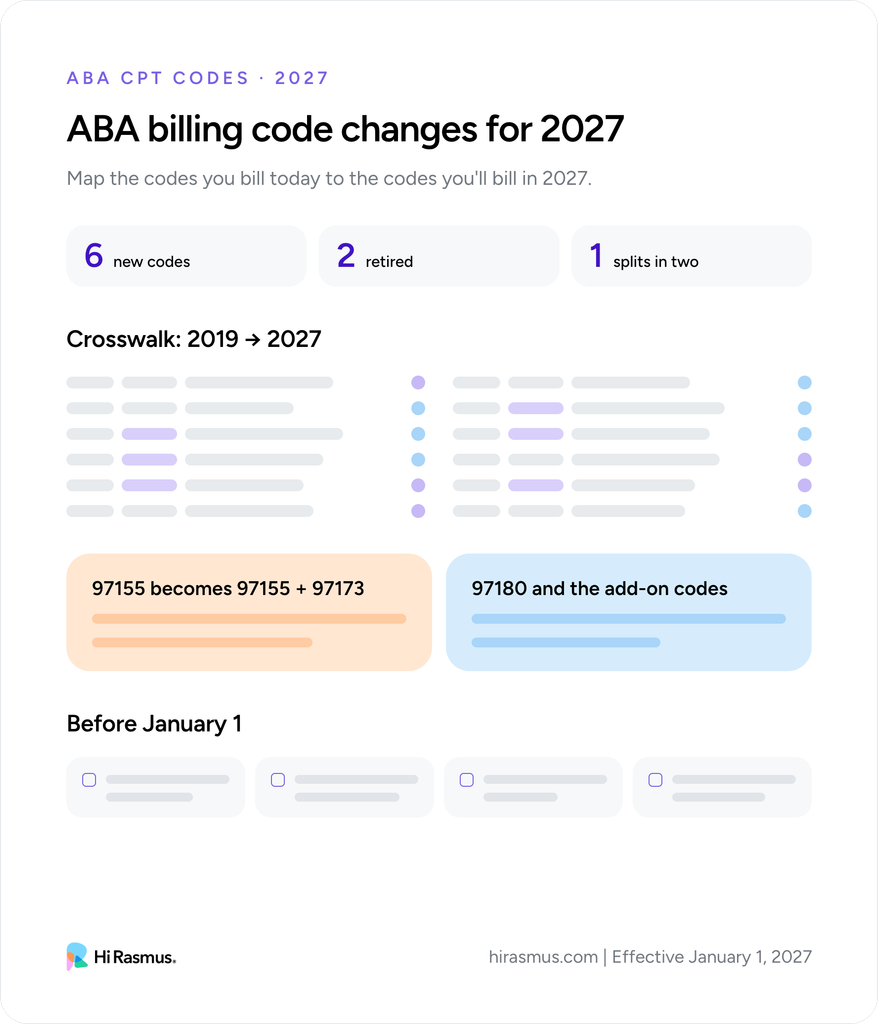
A One-Page Guide to the 2027 CPT Code Changes
The guide puts the 2027 changes on one page so clinical teams can easily track what’s changing before January 1. It’s organized into three parts —
- Old to new: how the 2019 codes map to the 2027 set, including 0362T becoming 97148 and 0373T becoming 97159.
- What’s new: the six new codes, including the add-on codes (+97149 and +97160) billed for each additional technician.
- What changes in use: the 97155/97173 split, and how 97180 bills weekly instead of per appointment.
Download the 2027 CPT Code Guide.
What’s Changing With the 2027 CPT Codes
- Six new codes join the set. 97148 and its add-on +97149 cover harmful-behavior assessment. 97159 and +97160 cover harmful-behavior treatment. 97173 and 97180 are both new — more on each below.
- The Category III codes are retired for good. 0362T and 0373T were always meant to be temporary — Category III is the AMA’s holding pattern for emerging procedures, with coverage that varies payer to payer. They’re now permanent Category I codes: 0362T becomes 97148 (plus +97149 for each additional technician), and 0373T becomes 97159 (plus +97160).
- 97155 splits into two codes. Under the 2019 set, 97155 covered two different things: a BCBA or other QHP treating a client directly, and a BCBA directing a technician’s work. Those are now separate. Direct QHP treatment gets its own new code, 97173. 97155 narrows to technician direction specifically.
- 97180 doesn’t look like the rest of the set. Every other code bills per 15 minutes, face-to-face, on a given date of service. 97180 covers a QHP’s non-face-to-face time — reviewing data, revising a protocol, planning a discharge — and it can be billed once a week, as a running total of that Sunday-to-Saturday period, rather than tied to one appointment.
- The add-on codes cover multiple technicians in one session. +97149 and +97160 are billed alongside their base codes for each additional technician present, up to five total. One session can now carry several technicians and several code lines.
Why the Codes Are Changing
The rationale behind the 2027 CPT code changes is worth knowing, not just the codes themselves. The Coding Coalition — the Association of Professional Behavior Analysts, Association for Behavior Analysis International, the Behavior Analyst Certification Board, and the Council of Autism Service Providers (CASP) — built this set from utilization data collected from health plans, providers, and other stakeholders. That data pointed to two gaps: clinical work that wasn’t separately billable before (where 97180 comes from), and descriptors ambiguous enough that providers, payers, and states were interpreting the same activity differently (where the 97155/97173 split comes from).
AMA President Willie Underwood III, MD, MSc, MPH put it plainly in the release announcing the set: “The continued evolution of the CPT code set demonstrates why a trusted, physician-led coding system is essential.” The goal is closing the gap between what a code says and what actually happens in a session.
What to Do Before January 1
- Check with your payers to see if there’s anything you need to do about authorizations that span the cutover date.
- Flag the 97155/97173 split for anyone billing from memory. A claim coded 97155 after January 1 means something narrower than it used to.
- Start the conversation with payers now — which codes they’ll recognize, which modifiers they’ll require, and how they’ll treat 97180 and the add-on codes are all payer-specific.
- Review your fee schedule for the six new codes, and confirm what happens to your rates for 0362T and 0373T once they’re retired.
Background
ABA’s own code set has held steady since 2019: eight codes, plus two temporary Category III codes, built around a model of care that made sense at the time. Practice has moved since then. Telehealth is routine in most states, and non-face-to-face clinical work — protocol updates, care coordination, the planning a QHP does between sessions — now takes up real hours that the old codes had no way to describe on their own. The 2027 set gives that work its own code for the first time: 97180, billed weekly rather than per visit, a shape that didn’t exist anywhere in this code family before.
Organizations running ABA technology are already asking themselves a practical question: over the next four to six months, what has to change in their systems — reporting, clinical documentation, appointment types — to be ready for the 2027 set on January 1. That’s not a hypothetical. It’s the same question providers were asking in 2018, the last time this happened.
The 2019 ABA code set went through the same kind of runway:
- September 4, 2018 — The AMA approved the new code set, about four months ahead of the effective date.
- January 1, 2019 — The new codes took effect. Many large payers converted on this date, but not all of them.
- Early-to-mid 2019 — Some payers’ plans were still in flux months after the effective date. The ABA Coding Coalition’s own guidance at the time said it was on each provider to confirm directly with their own payers rather than rely on a single timeline.
- Through 2019 — Medicare and Medicaid ended up with different utilization limits for a stretch.
A period of not-fully-knowing how every payer will handle a new code set isn’t a sign something’s off. It’s what happens the first few months after any code set changes, and it happened last time too.
What Readiness Looks Like for an ABA Practice
The 2027 set won’t be the last change ABA practices have to absorb. Every few years, a code set is revised, a payer updates its own requirements, or a state changes what it covers under Medicaid. The practices that handle those changes well share a few habits that go beyond any single update.
Documentation built to extend, not rebuild. A practice whose session notes and billing setup are tied tightly to today’s exact code list ends up rebuilding that setup every time a descriptor changes. The alternative is treating each code as one entry in a system built to add, retire, and revise entries, so a change updates one piece rather than requiring a redesign.
Direct contact with payers, not assumptions. The 2019 transition showed this clearly: payer timelines varied enough that providers had to confirm requirements directly rather than rely on a single published schedule. That’s still true for any code change. The practices that ask early get a straight answer sooner; the ones that wait find out from a denied claim.
Billing and clinical teams reading from the same page. A code change touches session notes and claims at the same time, and a documentation template that doesn’t match what a code requires shows up as a billing problem later. Practices where clinical and billing staff review a change together, rather than separately, catch the mismatch before it reaches a claim.
A direct line to the organizations publishing guidance. CASP, the AMA, the ABA Coding Coalition, and individual state Medicaid programs are the sources actually setting the terms of a change. Practices that follow those sources directly move on real information; the ones relying on word of mouth move on whatever’s made it around by then.
None of this is specific to the 2027 set. It’s what holistic readiness looks like for a field that will keep revising its own billing language as the work itself keeps evolving, and it’s the same posture Hi Rasmus’s own partnerships are built around.
What This Looks Like Inside Hi Rasmus
Here’s where the 2027 set touches Hi Rasmus directly, what we already know, and what’s still being worked out.
Billing. CPT codes are billed through whichever system a practice uses for revenue cycle management, such as a clearinghouse, a payer portal, or an integration partner. Hi Rasmus integrates with Lumary, Camber, AlohaABA, and Boost, and the billing for these codes happens in those systems, outside Hi Rasmus itself. Each partner will be working from CMS and payer guidance as it comes out, and we’ll share what we learn as the details become clear.
Hi Rasmus Scheduling. Treatment services can be built based on CPT codes and attached to a scheduled appointment. New services can be set up in scheduling settings. If you use services to schedule appointments, add any updated services to the client’s Treatment Services list on the client’s Services tab, or set the service to allow unauthorized scheduling. That way the right codes carry through into the session note, so documentation is accurate. Subscribe to our changelog for updates.
CASP. Hi Rasmus is a CASP Business Affiliate, a status the Council of Autism Service Providers grants to organizations that align with its standards for evidence-based ABA and its work on ACQ accreditation. CASP’s ABA session note templates cover each adaptive behavior CPT code, matched to AMA documentation requirements and CASP’s own ABA Practice Guidelines. Today’s templates cover the current code set: 97151 through 97158 and the T-codes 0362T and 0373T. When CASP updates those templates for a new code set, as it’s done before, Hi Rasmus updates its own platform templates to match. For more information or help adding CASP session note templates to your Hi Rasmus account, please contact help@hirasmus.com
What to expect: We’re tracking the rollout closely, focusing on the areas above that are most likely to need attention, and we’ll act as payer guidance and crosswalks firm up. It’s the same approach the field took in 2019, and code sets will keep evolving as ABA matures. Each change can be hard to navigate in the moment, and these updates are meant to make documentation and billing reflect the actual clinical work more accurately. That means clinicians spend less time untangling paperwork and more time with the child in front of them. Getting there takes real effort from clinicians and teams who adapt their practice every time this happens, and that effort keeps care moving for the families who depend on it.
Frequently Asked Questions
Do I need to update authorizations that are already active? Check the end date against January 1, 2027. If an authorization extends past the cutover, talk to the specific payer about whether a new auth is required or whether they’ll accept a mapped code on the existing one.
Are reimbursement rates changing along with the codes? Not as part of this release — the AMA’s crosswalk defines what each code covers, not what payers pay for it. CMS extended carrier pricing for adaptive behavior codes through 2027, so there’s no set Medicare rate to benchmark against. CMS issued the proposed 2027 Medicare Physician Fee Schedule on July 14, 2026, with the final rule expected in November 2026. Until then, expect rates to be negotiated payer by payer rather than benchmarked against an existing number.
Do the modifiers change too? No. The modifiers commonly used with these codes — HM, HN, HO, and HP, tied to provider education level — carry over unchanged.
What happens if a funder still requires 0362T or 0373T after they’re retired industry-wide? That’s a normal part of a transition like this — some funders lag behind an AMA update. Since a service in Hi Rasmus is just a CPT code attached to a scheduled appointment, a retired code can still be set up as its own service for the funders who require it, alongside the new codes for everyone else.
What’s the best way to keep up to date with Hi Rasmus? Subscribe to our changelog for product updates as they roll out, including anything related to the 2027 code set.
Sources
- AMA releases CPT 2027 code set, American Medical Association, September 9, 2026
- 2027 CPT Code Crosswalk, ABA Coding Coalition, September 11, 2026
- ABA Coding Coalition
- ABAI conversion chart letter, September 4, 2018
- ABA Coding Coalition — MUEs and payer implementation
- CASP ABA session note templates
- CMS releases proposed 2027 Medicare Physician Fee Schedule, CASP
This is for general information and isn’t billing or legal advice. Confirm code, modifier, and authorization requirements with each payer before the January 1, 2027 effective date.