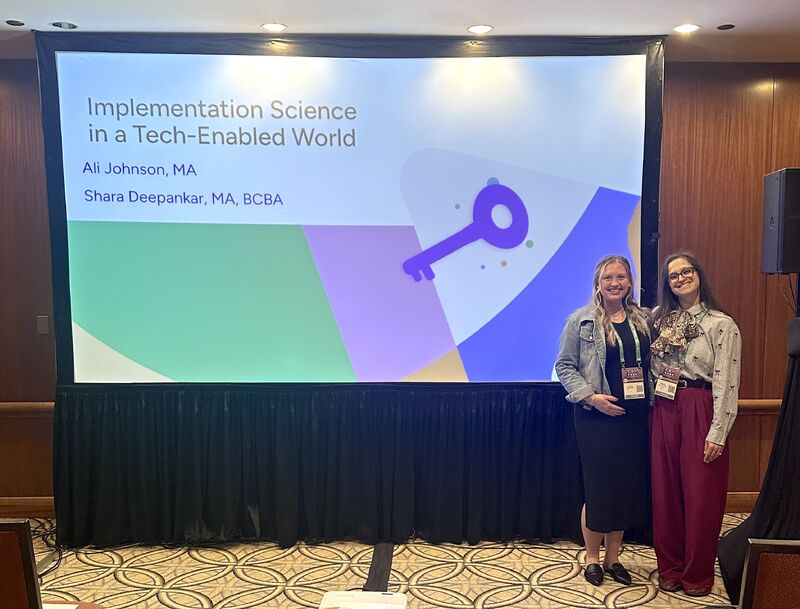
At the 2026 Women in Behavioral Analysis (WIBA) conference in Chicago, two members of the Hi Rasmus team took the stage to make a case that isn’t made often enough: BCBAs who happen to work with technology.
Shara Deepankar, MA, BCBA (Implementation Manager) and Ali Johnson, MA (Growth Manager) presented “Implementation Science in a Tech-Enabled World,” a session built around one central idea: the gap between what works and what actually gets used isn’t a technology problem. It’s a behavior problem. And behavior analysts are already trained to solve it.
The Problem: A Know-Do Gap
The session opened with a hard number. Fewer than 50% of clients in behavioral health receive care that reflects current evidence. That gap isn’t theoretical. It shows up in the week-six email nobody replies to, the platform that gets used at 20% capacity, and the team that gets onboarded onto new software only to quietly slide back to paper.
Shara and Ali’s point: the tools themselves are usually fine. Well-designed, evidence-informed, clinically sound. The failure happens in the space between knowing and doing, which is exactly the space implementation science was built to study.
The Reframe: Customer Success as Implementation Leadership
One of the session’s sharpest moments was a reframe of what customer success actually is. On paper, it can look like a support function: answer the email, close the ticket, schedule the training. But underneath that, what it actually is, is implementation leadership. That distinction matters, especially for an audience of BCBAs who might not yet see how directly their clinical training maps onto systems-level work.
The Framework: EPIS
The core of the presentation walked through the EPIS framework, a four-phase model for organizational change: Exploration, Preparation, Implementation, and Sustainment. Rather than keeping it abstract, Ali and Shara grounded each phase in a running example of three fictional organizations at different scales, a small practice, a mid-size group, and an enterprise system, showing how the same framework plays out differently depending on organizational size and readiness.
A few ideas that stuck:
- Exploration is a functional assessment of the organization, not just the learner. The question isn’t what the new system looks like, it’s what it needs to do.
- Superusers are selected for credibility and workflow fluency, not seniority. Availability isn’t the bar. The right superuser changes behavior at the organizational level, not just learns a system.
- Sustainment is prompt fading at the organizational level. New behaviors maintained only by external support will extinguish when that support fades. The goal is contacting natural reinforcers already inside the organization: efficiency, better outcomes, reduced burden.
Why This Session Mattered for a Women in Behavioral Analysis Audience
Woven through the technical content was a message aimed squarely at the WIBA audience: the field of ABA is over 85% women, and that same clinical skill set, reading an environment, designing behavior change, measuring fidelity, is precisely what systems and implementation roles require. Shara and Ali made the case that moving into a systems role isn’t leaving clinical work behind. It’s the same care clinicians already give, reaching further into the rooms where decisions about care are being made.
Hi Rasmus’s BCBAs, Leading From the Inside
Part of what gave the session its credibility is that this isn’t a hypothetical case for Hi Rasmus. The company’s own team is built around BCBA-led implementation, with clinicians occupying roles that didn’t widely exist a decade ago.
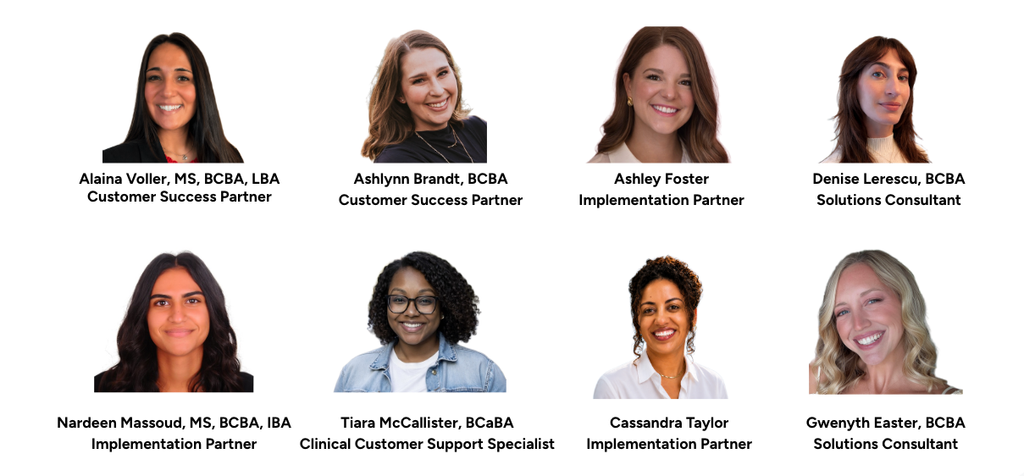
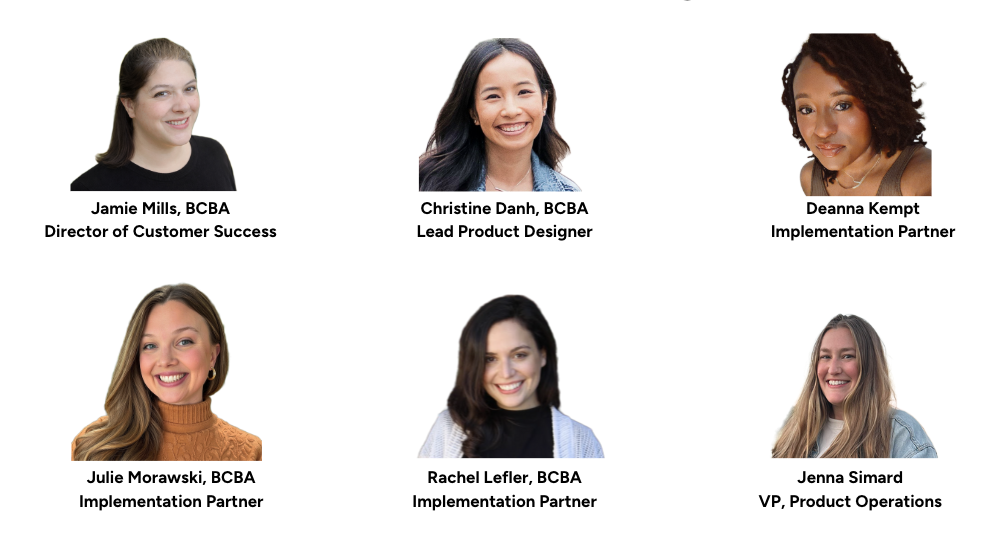
Having BCBAs embedded across customer success, product design, and implementation is a structural choice, not a talking point. It means the people helping practices roll out new tools are the same people who understand why a behavior technician might quietly go back to paper at week three, and what to do about it.
The Takeaway
Ali and Shara closed with a simple line: it was never about the technology. Implementation is a behavior change process, not a technology outcome. The framework exists, the science exists, and increasingly, so do the roles built to carry it out.
For the practitioners in the room, that’s the real invitation: the skills that already make someone an effective BCBA are the same skills organizations need at the systems level. The handout from the session, including the full EPIS breakdown and the questions to bring back to your own team, is available at tinyurl.com/epishandout.